
CNMI History
From ancient Chamorro villages to the battles of 1944 and the Covenant with the United States, discover how Saipan, Tinian and Rota shaped the Pacific and became part of America.
Four Flags, One Strategic Crossroads
The Northern Mariana Islands have been ruled by Spain, Germany, Japan and the United States. Their location in the Western Pacific, roughly midway between Japan and New Guinea, has made them strategically valuable for centuries, and nowhere was that clearer than in 1944 and 1945, when Saipan and Tinian became the launch point for the final air campaign against Japan. That military significance shaped the islands' path from a UN trust territory to a U.S. commonwealth whose residents are American citizens.
Timeline of the Northern Marianas
- c. 1500 BC
First settlers arrive
Seafaring ancestors of the Chamorro people settle the Mariana Islands, later building the distinctive latte stone foundations found across Saipan, Tinian and Rota.
- 1521
Magellan reaches the Marianas
Ferdinand Magellan’s expedition becomes the first European voyage to reach the islands.
- 1565 – 1668
Spanish claim and colonization
Miguel López de Legazpi claims the islands for Spain in 1565. Jesuit missionaries led by Diego Luis de San Vitores arrive in 1668, beginning sustained Spanish rule.
- Late 1600s
Spanish–Chamorro wars and relocation
Decades of conflict and disease devastate the Chamorro population. Spain relocates most residents of the northern islands to Guam; Rota is the only northern island that keeps a continuous Chamorro population.
- 1898 – 1899
Spanish–American War divides the Marianas
The United States takes Guam in 1898. In 1899 Spain sells the Northern Marianas to Germany, separating them politically from Guam for the next half century.
- 1914 – 1920
Japan takes control
Japan seizes the islands at the start of World War I. In 1920 the League of Nations grants Japan a mandate, and Saipan becomes the center of a large sugar industry.
- June – July 1944
Battle of Saipan
U.S. Marines and Army troops land on Saipan on June 15, 1944. The island is declared secure on July 9 after some of the fiercest fighting of the Pacific War.
- July – Aug 1944
Battle of Tinian
U.S. Marines land on Tinian on July 24, 1944, and secure the island by August 1 in what is often called a near-perfect amphibious operation.
- Aug 1945
The atomic missions fly from Tinian
B-29s of the 509th Composite Group take off from North Field, Tinian, for the atomic missions over Hiroshima (August 6) and Nagasaki (August 9). Japan surrenders weeks later; the bypassed garrison on Rota surrenders in September 1945.
- 1947
UN Trust Territory
The islands become part of the Trust Territory of the Pacific Islands, a United Nations strategic trusteeship administered by the United States, first under the U.S. Navy.
- 1975
The Covenant
The Covenant to Establish a Commonwealth of the Northern Mariana Islands in Political Union with the United States is signed on February 15, 1975, and approved by about 79% of voters in a June 1975 plebiscite.
- 1976 – 1978
Commonwealth established
President Gerald Ford signs the Covenant into U.S. law on March 24, 1976. The CNMI constitution and first locally elected government take office on January 9, 1978.
- 1986
U.S. citizenship
President Ronald Reagan proclaims the end of the trusteeship for the Northern Marianas on November 3, 1986, and eligible residents become U.S. citizens. The UN Security Council formally confirms the change in 1990.
- 2008 – Today
Deeper federal integration
Federal immigration law is extended to the CNMI and the Commonwealth gains a delegate in the U.S. House of Representatives, first seated in 2009. The islands remain an important part of U.S. defense planning in the Western Pacific.
Saipan
The decisive battle that broke Japan’s inner defense line
Saipan is the largest island and the capital of the CNMI. Under Japanese rule it was a busy sugar and administrative center with a large civilian population, and Japan treated it as a vital part of its inner defensive perimeter.
Japanese stronghold
Between the world wars, tens of thousands of Japanese and Okinawan settlers came to Saipan to work the sugar plantations. In the years before 1944 the island was heavily fortified and garrisoned by about 30,000 Japanese troops.
The Battle of Saipan (1944)
As part of Operation Forager, U.S. Marines and Army troops landed on the island’s western beaches on June 15, 1944. While the fighting raged ashore, the U.S. Navy won the Battle of the Philippine Sea nearby (June 19–20), destroying much of Japan’s carrier air power. Saipan was declared secure on July 9. Almost the entire Japanese garrison was killed, the United States suffered more than 3,000 killed and many thousands wounded, and thousands of civilians died, many of them at what are now called Suicide Cliff and Banzai Cliff.
Why it mattered
The loss of Saipan put Tokyo within range of the new B-29 Superfortress and led to the resignation of Prime Minister Hideki Tojo’s cabinet. Aslito airfield was rebuilt as Isley Field, and B-29s began bombing the Japanese home islands from it in November 1944.
After the war
The U.S. Navy administered Saipan for years after the war, and in 1962 Saipan became the headquarters of the Trust Territory of the Pacific Islands. Today it is the seat of the Commonwealth government.
Historic Sites to Visit
- American Memorial Park
- Invasion landing beaches
- Suicide Cliff and Banzai Cliff
- Last Japanese Command Post
- Isley Field (Aslito) historic landmark
Tinian
Home of North Field, the busiest airfield of World War II
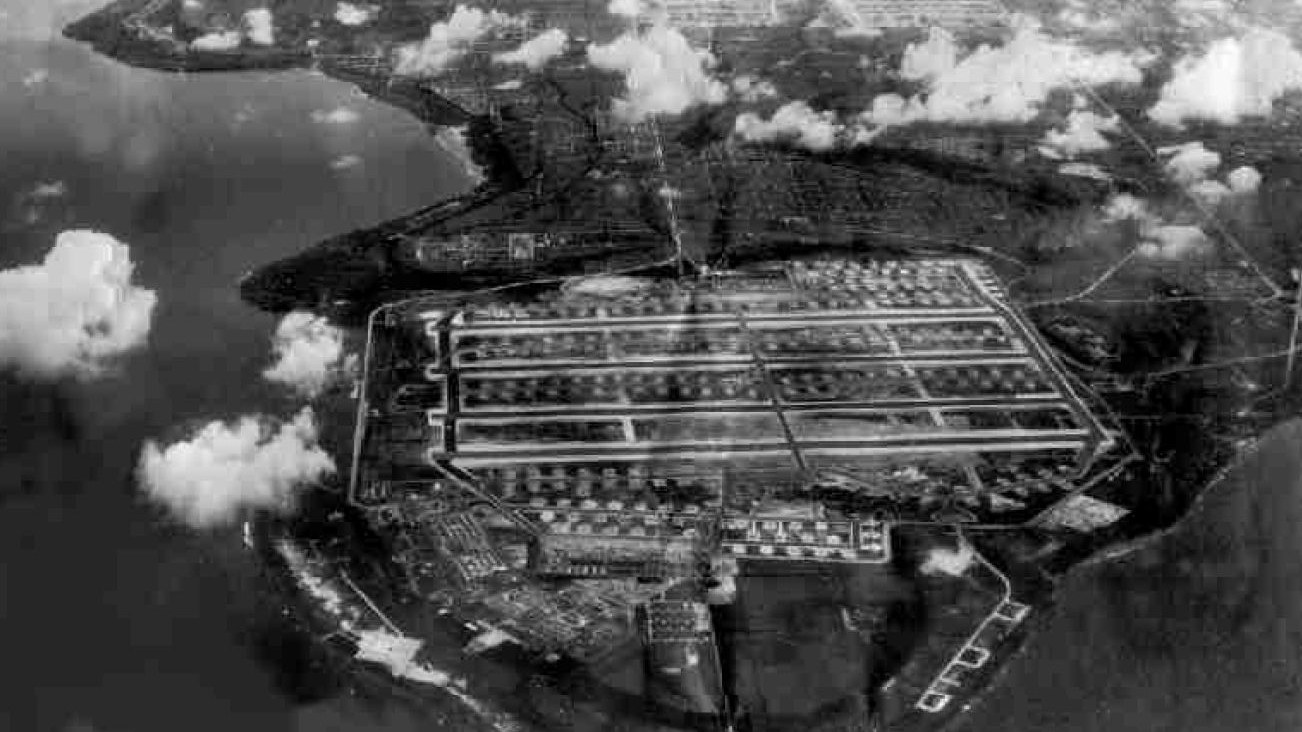
Tinian is flat and fertile, which made it ideal for sugar cane under Japanese rule and, after 1944, for building heavy-bomber runways. Its role in the last year of the war makes it one of the most significant places in modern military history.
The Battle of Tinian (1944)
Just a few miles across the channel from Saipan, Tinian was invaded on July 24, 1944. A feint toward Tinian Town drew Japanese attention while Marines landed on small beaches in the north. Napalm was used in combat for one of the first times, and the island was secured by August 1.
North Field and West Field
Navy Seabees rapidly turned the island into an enormous air base. North Field, with four 8,500-foot runways, became the largest airfield in the world in 1945, and West Field was built alongside it. Hundreds of B-29s flew from Tinian on firebombing missions against Japan.
The atomic missions
The 509th Composite Group was based at North Field. On August 6, 1945, the B-29 Enola Gay took off from Tinian carrying the bomb dropped on Hiroshima, and on August 9 Bockscar flew the Nagasaki mission. The bomb loading pits are preserved today as part of the North Field historic district.
A continuing military role
Under the 1975 Covenant, the United States leases roughly two-thirds of Tinian for defense purposes. The island hosts training exercises, and West Field is now Tinian International Airport, where the U.S. Air Force is developing divert airfield capabilities.
Historic Sites to Visit
- North Field National Historic Landmark
- Atomic bomb loading pits
- Unai Chulu and Unai Babui landing beaches
- House of Taga latte stones
- Japanese air administration building ruins
Rota
The bypassed island that kept its Chamorro heritage
Rota (Luta) is the southernmost of the three main islands and the closest to Guam. It was the only northern island to keep a continuous Chamorro population through Spanish rule, and today it remains the most traditional of the three.
Under Japanese rule
During the Japanese mandate, Rota was developed for sugar cane and phosphate mining. A sugar mill and narrow-gauge railway were built near Songsong village, and coastal defenses were installed to protect the island.
Bypassed in World War II
Rota was never invaded. U.S. forces chose to bypass it and neutralize it from the air and sea, repeatedly bombing its airfield while the Japanese garrison was cut off from resupply. The garrison held out until Japan’s surrender and formally surrendered in September 1945.
After the war
Rota became part of the U.S.-administered Trust Territory and later the Commonwealth. Its people took part in the political status talks of the 1970s that led to the Covenant with the United States.
Historic Sites to Visit
- Japanese coastal defense gun
- Japanese sugar mill ruins at Songsong
- Taga Stone Quarry (As Nieves)
- Mochong latte stone village site
How the CNMI Became a U.S. Commonwealth
Unlike Guam, which became American in 1898, the Northern Marianas chose their political union with the United States by a vote of their own people, a path that took more than forty years after the end of World War II.
Liberation and military government
After the 1944 battles, the U.S. military governed Saipan and Tinian while the war continued. Civilian internment camps housed local residents and Japanese civilians until the war ended.
UN strategic trusteeship (1947)
The United Nations placed the former Japanese mandate under U.S. administration as the Trust Territory of the Pacific Islands. As a strategic trust, it gave the United States the right to establish military bases in the islands.
A vote for closer ties
Through the 1950s and 1960s, Northern Marianas voters repeatedly expressed a wish for closer ties with the United States. In 1972 the Marianas Political Status Commission began separate talks with the U.S. government.
The Covenant (1975 – 1976)
The Covenant was signed in 1975, approved by voters in a UN-observed plebiscite, and enacted by Congress as Public Law 94-241 in 1976. It established a self-governing commonwealth under U.S. sovereignty and included long-term land leases for defense use on Tinian and Farallon de Medinilla.
Self-government (1978)
The CNMI adopted its own constitution and elected its first governor and legislature, which took office on January 9, 1978.
Citizenship and full status (1986 – 1990)
The trusteeship ended for the Northern Marianas in 1986 and eligible residents became U.S. citizens. The UN Security Council formally ended the trusteeship in 1990, making the CNMI a fully recognized U.S. commonwealth.
The Military Presence Today
The CNMI remains a key part of U.S. defense posture in the Western Pacific, alongside nearby Guam.
Tinian lease area
Under the Covenant, the U.S. leases roughly two-thirds of Tinian for defense use. The area supports military training and joint exercises in the region.
Divert airfield
The U.S. Air Force is developing divert airfield capabilities at Tinian International Airport, giving aircraft an alternate operating location in the region.
Farallon de Medinilla
This small uninhabited island north of Saipan, also leased under the Covenant, has long served as a U.S. military training range.